
V838 Mon – How We “Turned” Hubble
How on February 2, 2002, four Czech amateur observers from our section captured the second outburst
of an unknown object in the constellation Monoceros — and thereby triggered a campaign that led all the way to the
Hubble Space Telescope.
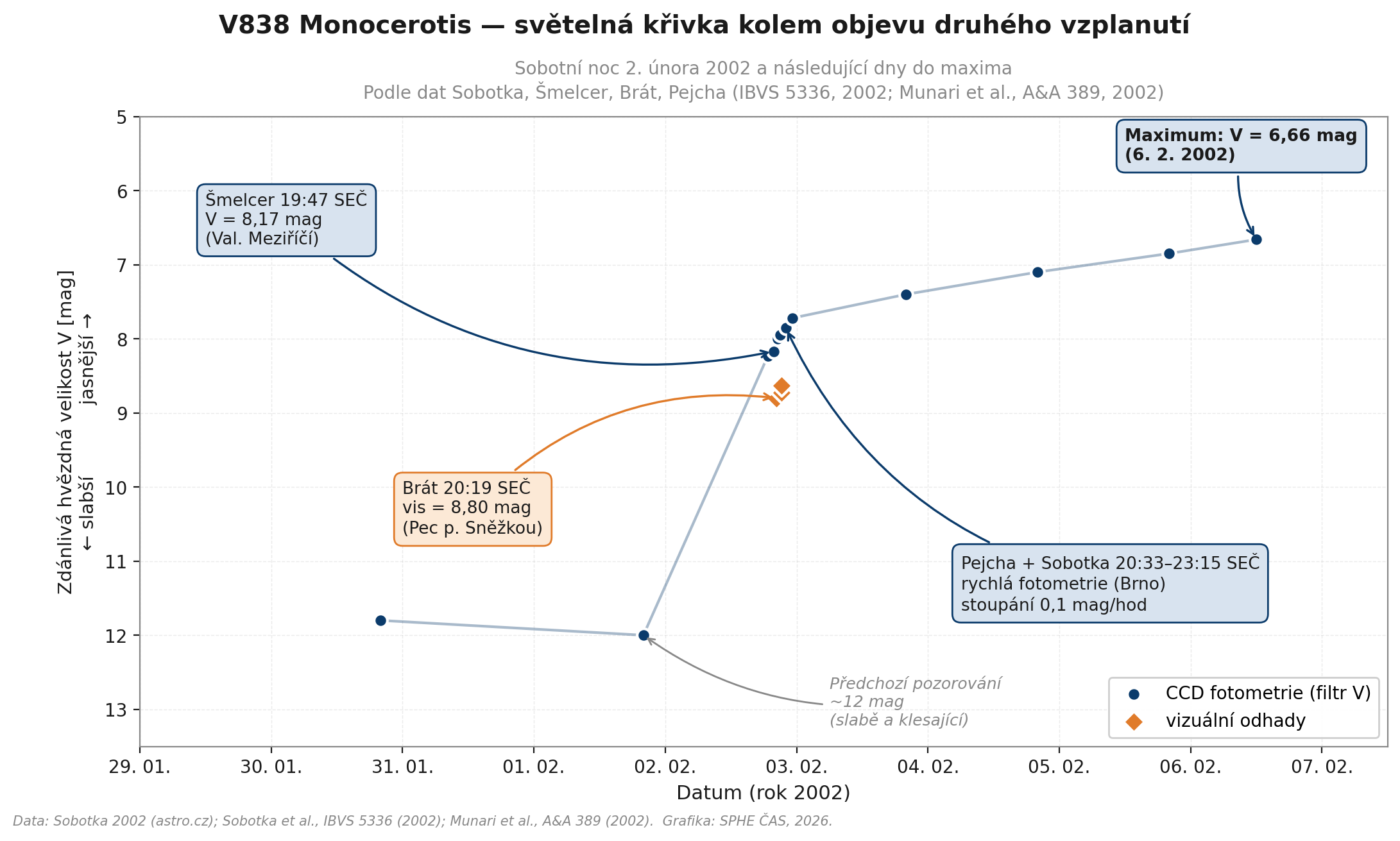
Saturday, February 2, 2002. After weeks of overcast skies, finally frost and clear weather. Ladislav Šmelcer at the Valašské Meziříčí Observatory points a CCD camera at the star V838 in the constellation Monoceros. A peculiar object, discovered a month earlier in Australia by Nicholas Brown, which until then almost no one in the Czech Republic had measured. At 7:47 PM CET, Šmelcer’s photometry shows 8.17 magnitude. That is nearly three magnitudes less than previous observations — and with stars, the lower the magnitude, the brighter it is. V838 Mon brightened about forty times within a few days. Šmelcer picks up the phone. Everything is just beginning ⇣
One Phone Call and a Campaign is Born
He calls Luboš Brát in Pec pod Sněžkou — also a long-time member of the section, also an observer of variable stars. Brát is just preparing his telescope for the constellation Monoceros. He only needs to point it. At 8:19 PM, he confirms visually. He immediately calls Ondřej Pejcha and Petr Sobotka at the Brno Observatory — also members of the section, also at their telescopes. Paradoxically, they were the first to have V838 Mon, which they considered a very interesting object, in their telescope. That was as early as 6:45 PM, but due to the overexposure of the first image and the subsequent filter change, they did not immediately recognize the ongoing changes. Then Brát runs home and at 8:29 PM sends a message to the international astronomical conference VSNET. That message starts a worldwide observation campaign. Within a few hours, people from literally all over the world join in observing V838 Mon. Meanwhile, in Brno, Pejcha and Sobotka start rapid photometry with an exposure every 20 seconds. At 11:15 PM, they send a report to the International Astronomical Union Circular. An hour later, they look at the plotted light curve and cry out in amazement — the star is rising at a rate of 0.1 magnitude per hour. Thus, it doubles its brightness every seven hours.
During that night, three other Czech observers from our section sent their independent observations to VSNET: Peter Dubovský, Kamil Hornoch, and Lukáš Král. At that time, several other observers and groups around the world also captured the brightening – this is not an exception for such dramatic events. However, the significance of a discovery is not decided by who was first by a few hours. It is decided by rapid confirmation, systematic monitoring, and interpretation. And that is exactly where our observers played their part.
Hubble, the Light Echo, and Something Entirely New
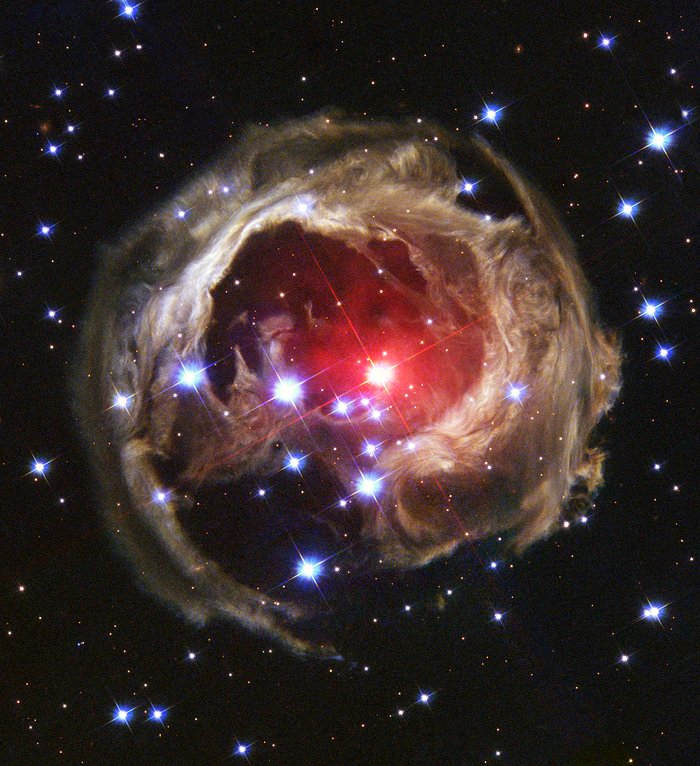
V838 Mon reached a maximum of V = 6.66 magnitude on February 6, 2002. Then it began to fade rapidly. In mid-February, however, what definitively made this object famous appeared around it — a light echo. The star’s flash gradually illuminated the dust in its vicinity, which until then could not be distinguished from the background. NASA therefore turned the Hubble Space Telescope toward V838 Mon. A series of images was created that today rank among the most famous astronomical images of the modern era (Bond et al., Nature 422, 2003). You can find an animation of the expanding echo in the video at the very beginning of this website — and now you know why it says underneath that we had a hand in it.
From a physical perspective, it turned out that V838 Mon is neither a classical nova (from a white dwarf in a binary system) nor a supernova (which tears the star apart). It reached a maximum luminosity roughly six hundred thousand times greater than the Sun, and its spectrum changed so dramatically over a few weeks that it did not fit into any previously known category of eruptive objects. In the following months, the star cooled so much that its spectrum corresponded to type L – a class otherwise reserved for brown dwarfs, yet it still shone as brightly as roughly one hundred thousand Suns. An object with the temperature of a dwarf and the luminosity of a supergiant. It was something new. The explanation that is considered most likely today was proposed in 2006 by Polish astronomer Romuald Tylenda and Israeli Noam Soker (A&A 451, 223). According to them, the eruption was the result of a stellar merger — a collision of a B-type main-sequence star with a mass of roughly eight Suns and a young stellar object with a mass of approximately four-tenths of the Sun. V838 Mon became the prototype of a new class of eruptive variables called luminous red novae (luminous red novae) and, along with the star V1309 Scorpii, which erupted six years later, remains one of the fundamental objects of this category today. Hubble, ALMA, infrared interferometers, and dozens of other observatories have returned to V838 Mon, many repeatedly. The eruption that Ladislav Šmelcer discovered just before eight in the evening in Valašské Meziříčí remains one of the best-documented cosmic events of the 21st century.
Why We Are Telling This Story
Šmelcer, Brát, Pejcha, and Sobotka did nothing extraordinary that night. They did what they did and
do many nights a year: they observed, measured, compared, and communicated. From the perspective of the variable star
section, it was almost routine. But a routine that has the quality of sometimes triggering
an avalanche. A scientific avalanche.
For the sake of completeness, let us add that Ondřej Pejcha, who was doing one of his first
independent nights with CCD technology in Brno that night, is now an associate professor of astrophysics at the Faculty of Mathematics and Physics
of Charles University (his research team, supported by two European ERC grants, is
among other things dealing precisely with stellar mergers — the mechanism behind V838 Mon).
Petr Sobotka worked for many years at the Astronomical Institute of the Czech Academy of Sciences and is now the secretary of the Czech
Astronomical Society. Ladislav Šmelcer remains a long-time pillar of our section for
the observation program focused primarily on eruptive variable stars. Luboš Brát
currently remains a member of the section but is more involved in other activities.
All of this can happen again — maybe tomorrow night, maybe next year. And to observe
variable stars today, you don’t need mega-scientific equipment. A telescope, a detector,
and the will are enough. If you want to be part of it, our doors are open to you.
- If you are interested in what we do, you are in the right place. Start here, for example – How to start.
- If you have further questions and want to discuss them with someone, contact us.
- If you are determined to “move” Hubble as well, join us.
Information sources in this article and useful links:
Works with a Czech footprint:
Sobotka, P.; Šmelcer, L.; Pejcha, O.; Král, L.; Kolasa, M.; Hornoch, K.; Lomoz, F. (2002):
“CCD Observations of the Outburst of V838 Mon”. Information Bulletin on Variable Stars No.
5336, November 2002. Full text in ADS
Škoda, P.; Šmelcer, L.; Brát, L.; Pejcha, O.; Sobotka, P. (2007): “Discovery of the Second
Outburst and Further Observations of V838 Mon in the Czech Republic”. In: ASP Conference
Series, vol. 363, The Nature of V838 Mon and its Light Echo, p. 59. Record on ASP Books
Sobotka, P. (2002): “Outburst of V838 Mon”. Astro.cz, 5. 2. 2002 — original Czech report
by one of the protagonists. astro.cz
Key IAU Circulars:
IAUC 7785 (Jan 10, 2002) — N. J. Brown announces the original discovery of the star.
IAUC 7812, 7816, 7822 (February 2002) — photometry and spectroscopy of the second outburst, including
data from Feb 2–3. 2. 2002.
IAUC 7842 — list of visual observations includes K. Hornoch, Lelekovice (CZ).
IAUC 7859 (Mar 25, 2002) — A. Henden, U. Munari, M. Schwartz announce the discovery of the light
echo (first captured on Feb 17, 2002).
International research — from discovery almost to the present:
Munari, U. et al. (2002): “The mysterious eruption of V838 Mon”. Astronomy&Astrophysics
389, L51 — first comprehensive description of the second outburst.
Kimeswenger, S.; Lederle, C.; Schmeja, S. (2002): “New eruptive variable: Nova Mon
2002″, MNRAS 336, L43 — description of the triple structure of the eruption.
Bond, H. E. et al. (2003): “An energetic stellar outburst accompanied by circumstellar light
echoes”, Nature 422, 405 — iconic images of the light echo from the Hubble Space
Telescope.
Tylenda, R. & Soker, N. (2006): “Eruptions of the V838 Mon type: stellar merger versus
nuclear outburst models”, A&A 451, 223 — stellar merger hypothesis as an explanation
for the eruption.
Sparks, W. B. et al. (2008): “V838 Monocerotis: A Geometric Distance from Hubble Space
Telescope Polarimetric Imaging of Its Light Echo”, AJ 135, 605 — determination of the star’s distance
using echo polarimetry.
Pastorello, A. et al. (2019): “Luminous red novae: Stellar mergers or giant eruptions?”, A&A
630, A75 — V838 Mon as a prototype for the entire class of LRNe in the Local Group.
Kamiński, T. et al. (2021): “V838 Monocerotis as seen by ALMA: A remnant of a binary
merger in a triple system”, A&A 655, A32 — current state of the merger remnant in radio
interferometry.
Other sources:
AAVSO — Variable Star of the Season (V838 Mon): aavso.org/vsots_v838mon
MEDÚZA group page on V838 Mon (in English, on the VSNET website in Kyoto): kusastro.kyoto-
u.ac.jp/vsnet/Novae/gsc4822.39.html
Hubble Heritage — gallery of V838 Mon images (NASA/ESA): Heritage Project


