Observation programs

varastro title | Observation programs
The VarAstro portal is a place for planning, publishing, and sharing observations. Credit: SPHE ČAS

The main activity of the SPHE ČAS consists of organizing joint research on variable stars and exoplanets. This creates a unique connection between professional and amateur astronomers (pro-am collaboration), which has a long tradition in the Czech and Slovak Republics.

Historically, we divided this activity into coordinated observation programs—which is why the name of this page remains. Today, however, we perceive it more as observational fields—areas the section deals with, each with its own specifics and rewarding targets. All these fields are linked by the VarAstro database, which maintains separate catalogs for them (eclipsing variable stars, physical variable stars, a unique catalog of new variable stars discovered by Czech observers called CzeV, and an exoplanet catalog) and offers tools for predicting minima and transits. Whichever you choose, this is where you will store your measurements and integrate them into collective scientific work. Don’t know where to start? See How to start.

Section observational fields:

  • Eclipsing variable stars
  • Multiple systems (quadruple stars)
  • Physical variable stars (eruptive and pulsating)
  • Exoplanets (transits)
pozor programy1 | Observation programs
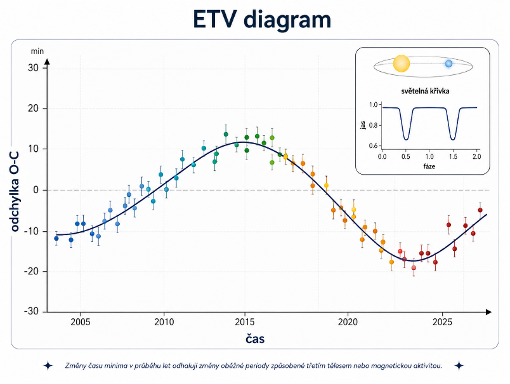
Changes in the timing of minima over the years indicate changes in the orbital period caused by a third body or magnetic activity. Credit: SPHE ČAS

Eclipsing variable stars

Eclipsing binaries are the oldest observational field of our section. For decades, it was overseen by the B.R.N.O. project (Brno Regional Network of Observers), whose name refers to the time when the section was closely linked to the Brno Observatory (more in the History of the section). The project was founded in 1960, became one of the most popular methods of observation in our country, and raised an entire generation of observers, and we are rightfully proud of it. Today, B.R.N.O. no longer functions as a coordinated project; it remains a vibrant and still valuable observational field that we continue to pursue.

Monitoring eclipsing binaries is relatively simple, yields quick results, and is ideal for beginners, as it is the perfect way to learn everything about acquiring precise photometric data. Furthermore, the systematic determination of the moments of light minima is an important area of stellar astronomy that still makes sense to pursue.

A number of interesting physical processes can be read from the light curve of an eclipsing variable star (starspots, disappearance of eclipses, mass transfer between binaries). However, the main result of the observation is the determination of the exact moment of the center of the eclipse. Eclipse predictions are based on the assumption that the change in brightness (given by the components orbiting a common center of mass) is periodic and therefore mathematically predictable for the future. By determining the moments of minima over a longer time scale (years to decades), deviations from the prediction, which manifest as a change in period, can be monitored for a star in an ETV diagram (Eclipse Timing Variation, formerly O–C diagram). This usually has a number of interesting physical causes (more in ETV diagrams).

pozor programy2 | Observation programs
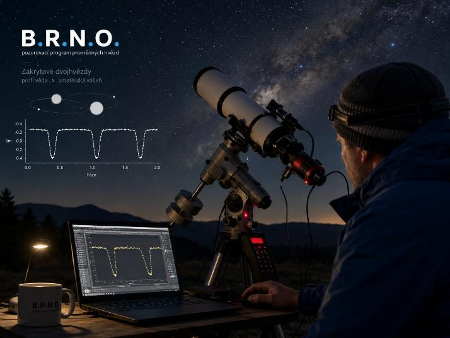
Credit: SPHE ČAS

Visual observation of eclipsing variable stars is practically no longer performed today and has almost no scientific value. The main method is taking images with CCD/CMOS cameras, or digital SLRs, followed by photometric data processing. Several observers also measure the minima of eclipsing variables with a photoelectric photometer.

How to get involved

This field does not have fixed coordination—simply follow the predictions in the catalog of “eclipsing variable” minima in the VarAstro database here and select stars of suitable brightness and observability for your setup. If a given binary does not have many observations (or enough recent ones), it is advisable to measure it at least one hour before the predicted minimum. The resulting reduced files (light curve and map) are uploaded to the database, where the eclipse parameters are determined using a built-in tool.

Field guarantor: Kateřina Hoňková, katerina.honkova@astronomie.cz

pozor programy3 | Observation programs
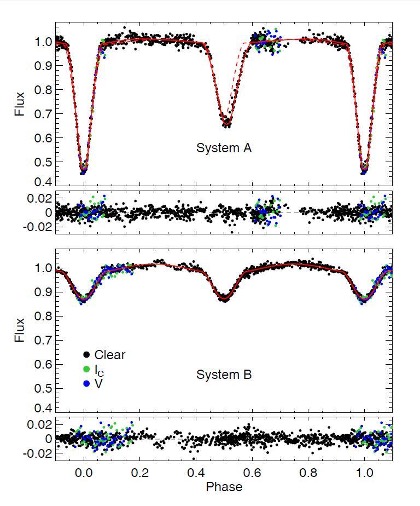
Light curve of the CzeV343 system after separation into individual components (system A + system B). Credit: SPHE ČAS

Multiple systems (quadruple stars)

Multiple eclipsing systems—systems where more than two components eclipse each other—are a field in which the Czech variable star community has left a significant international mark. They represent a unique laboratory for studying the dynamics and physical properties of stars: they allow their basic parameters to be determined with extraordinary precision and gravitational interactions to be monitored in a multi-body environment.

History and Czech discoveries

The section has long supported the collaboration of professional and amateur astronomers in the discovery and analysis of variable stars, and it has also made a mark in the international context specifically in the area of multiple systems. The first object of this type was discovered in 2013 by Pavel Cagaš; its light curve showed multiple types of eclipsing phenomena simultaneously, making it one of the first known representatives of this rare class. The second of the Czech discoveries, CzeV1731, was subsequently described in detail and published as only the third multiple eclipsing system in the world with such a clearly proven structure.

These successes were followed by further analyses and discoveries by SPHE members, which brought international recognition to Czech astronomy and showed that even smaller observatories and enthusiastic individuals can significantly contribute to world-class research.

pozor programy4 | Observation programs
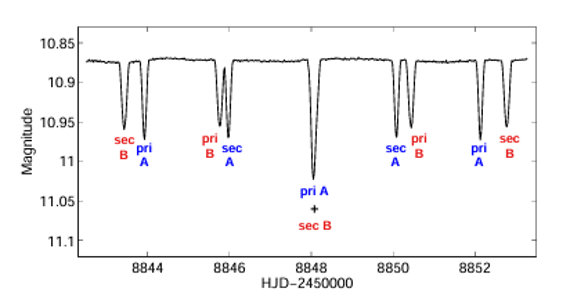
Measured light curve of the multiple system CzeV1731 from the TESS database. Credit: SPHE ČAS and Zbyněk Henzl

This historical foundation is now followed by the QUADRUPLES program, which systematically coordinates research on multiple eclipsing systems in our country.

Scientific significance and methodology

  • Determination of stellar parameters: by combining photometry and spectroscopy, the masses, radii, and temperatures of individual components can be accurately determined.
  • Dynamic interaction: monitoring changes in eclipse epochs (O–C diagrams) allows for the detection of additional components or secular changes in orbital inclination.
  • Model calibration: multiple systems are key objects for refining models of stellar structure and evolution.
  • Exoplanetary context: knowledge of the dynamics of these systems helps in understanding the formation and stability of planets in multi-star environments.

Methods used include the analysis of satellite data (TESS, Kepler), targeted ground-based photometry, radial velocity spectroscopy, and numerical modeling, often performed in close collaboration between professional and amateur astronomers.

Where we are heading

  • Creation of a database of multiple eclipsing systems, their analysis, and finding systems where obvious changes occur,
  • Expanding the sample to include less explored types of systems,
  • Involving a wider community of observers in long-term monitoring campaigns,
  • Linking photometric and spectroscopic data with astrometry from the Gaia mission.

Field guarantor: Zbyněk Henzl, zbynek.henzl72@gmail.com

pozor programy7 | Observation programs
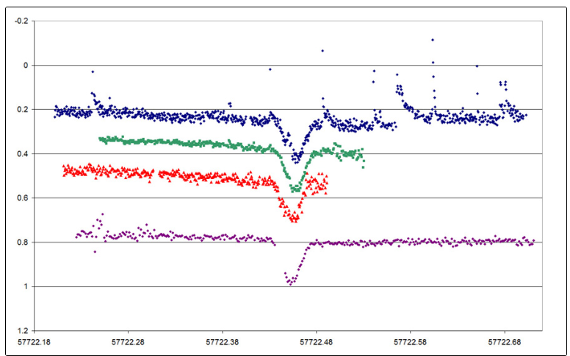
Photometry of the object GJ 3236 with numerous flares. Credit: SPHE ČAS and Ladislav Šmelcer

Physical variable stars

Physical (intrinsic) variable stars change brightness through changes directly within their interior or atmosphere. In our activities, we focus on two of their areas—eruptive and pulsating variable stars.

▶︎ Eruptive variable stars

Observation of flares in dwarf eclipsing binaries and chromospherically active stars with exoplanets. The goal of this field is to monitor possible flare activity in eruptive eclipsing binaries, in addition to determining the moments of minima and the possible discovery of a third star in the system (LITE effect).

In solar flares, a connection has been found between the Sun’s activity and the form of its magnetic field. For this reason, the idea arose to systematically monitor flares in other stars as well. Unlike the Sun, we are currently unable to estimate the basic characteristics of eruptive events, their frequency and intensity, and possible periods of increased probability of these phenomena. Periodicity is not known due to the small number of observation series. The cause of the flares is also not entirely clear. These are likely energetic processes in the magnetic field, but due to the great distance of the stars studied, there is no absolute certainty.

pozor programy8 scaled | Observation programs
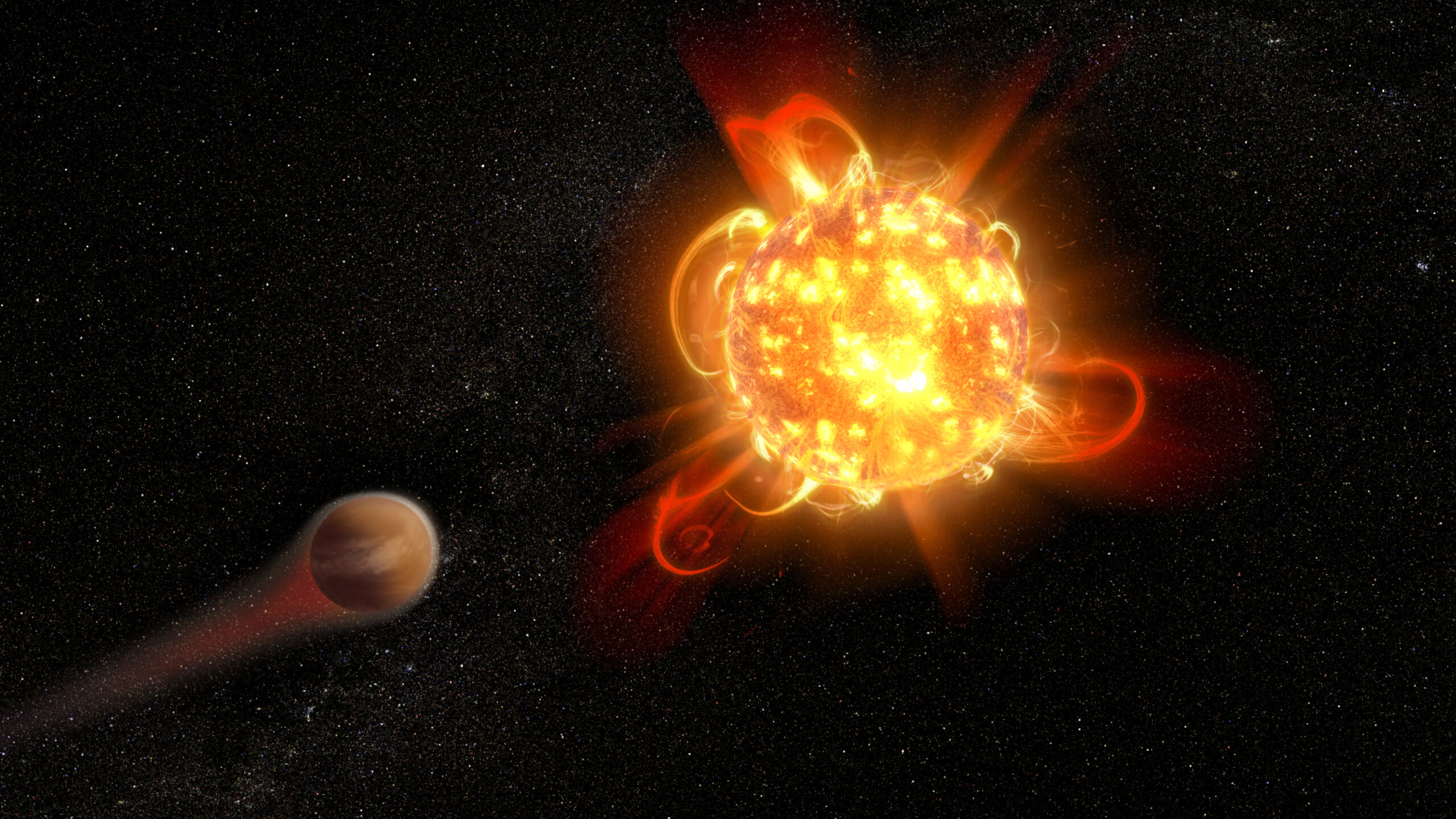
Artist's impression of an active red dwarf during a flare; its radiation affects the atmosphere of a nearby planet. Chromospherically active dwarfs and their influence on exoplanets can be one of the targets of this field. Credit: NASA, ESA, D. Player (STScI).

The basic prerequisite is the selection of stars similar to the Sun or slightly cooler red dwarfs, which should be more active. It is advantageous to monitor dwarf stars showing emission in certain spectral lines, which indicates their higher activity. These are stars of spectral classes dKe – dMe.

We are currently expanding this field to include flare photometry in multiple filters. The result of the collaboration with the University of Wrocław will be the analysis of flare light curves and the determination of flare temperature profiles from them.

As part of the preparation for the ARIEL project, in addition to observing exoplanet transits of interest, there will be the possibility of monitoring chromospherically active stars and possible interactions with exoplanets. Currently, the selection of interesting objects and the establishment of cooperation with the Netherlands Institute for Radio Astronomy (ASTRON) are underway.

Field guarantor: Ladislav Šmelcer, lsmelcer@seznam.cz

Animation of a pulsating variable star—the star expands and contracts, changing its brightness in the process. Credit: NASA, ESA, M. Kornmesser (ESA/Hubble).

▶︎ Pulsating variable stars

Pulsating variable stars change brightness through the regular expansion and contraction of their outer layers. For observers in our section, however, they usually do not represent the main observational field. In many of them (for example, Delta Scuti type stars), the changes in brightness are rapid and small, and observers find more rewarding applications in other types of variables.

An exception worth observing are RR Lyrae type stars. They are important “standard candles” for determining distances and are traces of the oldest stellar populations in the Galaxy and in globular clusters. Furthermore, some of them exhibit the still not fully explained Blažko effect, a slow modulation of the amplitude and shape of the light curve, the monitoring of which requires precisely the long and regular series of measurements that amateur observers can also provide.

Field guarantor: Zbyněk Henzl, zbynek.henzl72@gmail.com

pozor programy11 | Observation programs
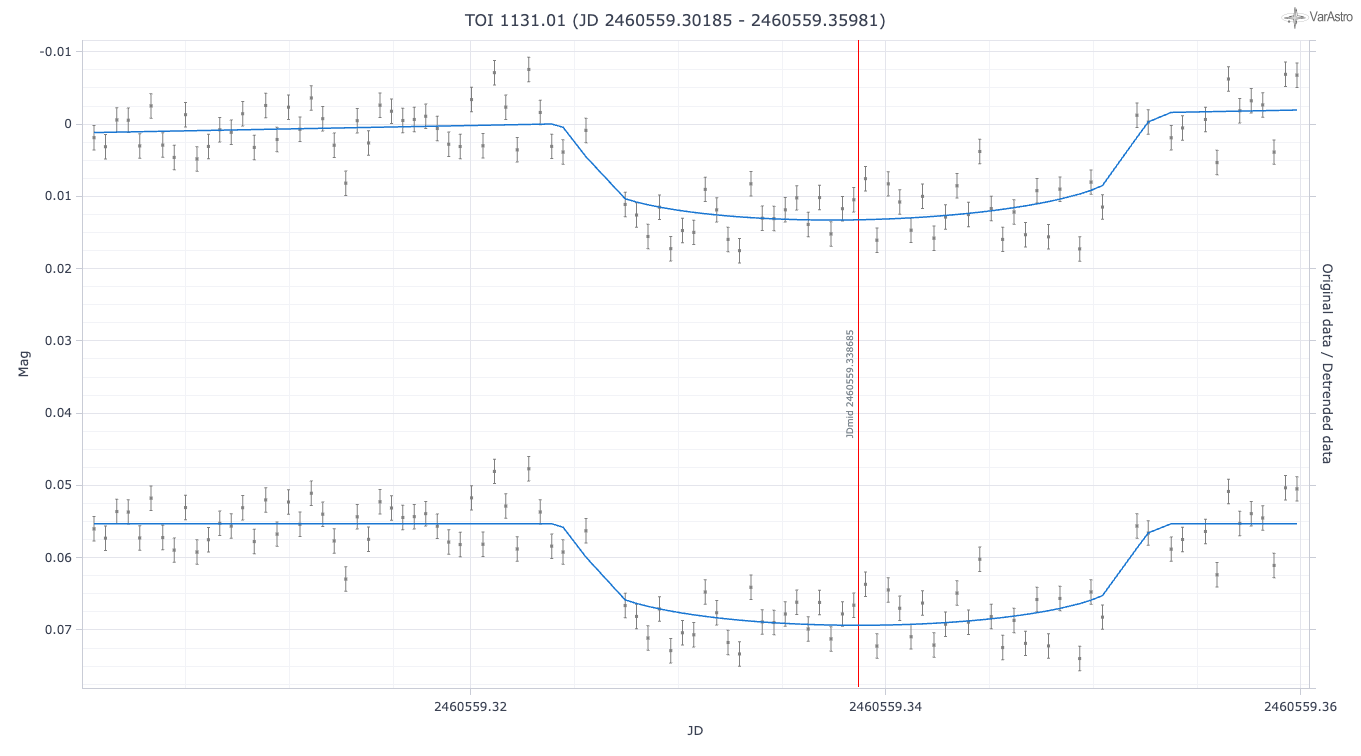
Light curve of the transit of exoplanet TOI 1131.01 b stored in the VarAstro/ETD database. The drop in brightness occurs when the planet passes in front of the host star. Credit: SPHE ČAS, observation by Manfred Raetz

Exoplanets (transits)

A field focused on monitoring exoplanets. More precisely, on monitoring transits of exoplanets across the host star.

Several dozen known extrasolar planets have an orbital trajectory oriented in space parallel to the direction of the terrestrial observer. In these systems, we observe the passage of the dark disk of the planet across the disk of the host star in each cycle (extrasolar planetary year). So-called transits occur.

Measured transits are stored in the ETD (Exoplanet Transit Database), which our section has been operating since 2008 as part of VarAstro [link: var.astro.cz/etd]. It is the largest and globally unique database of transit observations; observers from all over the world contribute to it, and it contains tens of thousands of light curves.

Furthermore, your measurement will not just stay in the database. Data from the ETD can serve further scientific research and publications. Thanks to the ETD’s cooperation with the international ExoClock project, they can also be involved in the preparation of the ESA Ariel mission, even if the observer does not contribute directly to ExoClock. Thus, with one measurement, your observation can reach two places at once.

The history of exoplanet discoveries, observation methods, and the section’s further involvement in international projects are covered in more detail on the separate Exoplanets page.

Field guarantor: Filip Walter, etd.varastro@gmail.com
pozor programy12 | Observation programs
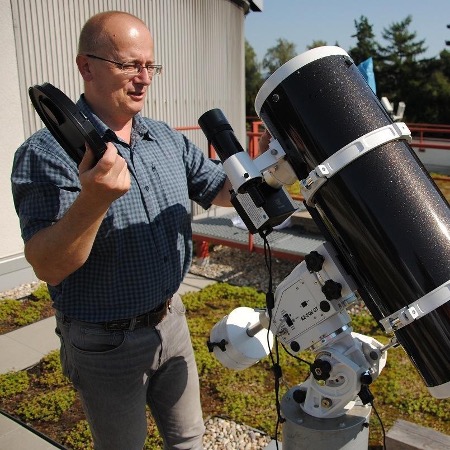
Short-term observation campaigns allow for a quick response to extraordinary astronomical phenomena and the requirements of professional astronomers. SPHE observers use their own as well as remotely controlled telescopes during these campaigns. Credit: SPHE ČAS

Short-term projects and campaigns

Observers also participate in other short-term projects or challenges from our and foreign professional astronomers, which are announced for a specific time period (for example, nova outbursts, symbiotic stars, unique eclipses, student theses).

You can find out about ongoing campaigns in the news on this website. Members have access to the Discord communication platform, where all current topics and observation suggestions are discussed live.

If you want to learn about all the possibilities for cooperation, we recommend visiting our November conferences and observation workshops, where the possibilities for involvement in specific projects are discussed the most.

Currently announced campaigns can also be found directly in the VarAstro database in the section What to observe → Projects and campaigns → [project selection]. An overview of current projects is here.