How to get started
From gazing at the night sky to making a significant discovery. Perhaps you simply enjoy astronomy—and perhaps one day your measurements will appear in a scientific publication. We will show you how to do it, whether you want to measure your first variable star, join us, or just come and take a look for now. You can start at any age, even without your own equipment. And you won’t be alone.
✔︎ No telescope of your own required
✔︎ We will guide you
✔︎ Experienced observers will advise you
Why observe and measure
Today, the sky is mapped night after night by automated surveys, and space telescopes orbit above our heads. So why does anyone still measure variable stars from their backyard? Because that is precisely where results are born that large missions cannot provide.
Both large telescopes and space missions have observation time scheduled months in advance, point at specific targets, and usually observe for only a short while. Kepler monitored a single field in the constellation Cygnus, TESS captures one sector for about a month, and Gaia measures the entire sky, but only at infrequent moments for any specific star. Meanwhile, there are over a million known variable stars.
- For the vast majority of them, no one is systematically monitoring what is happening to them right now. This gap is filled by observers with their own equipment—and our section has been part of this for a hundred years.
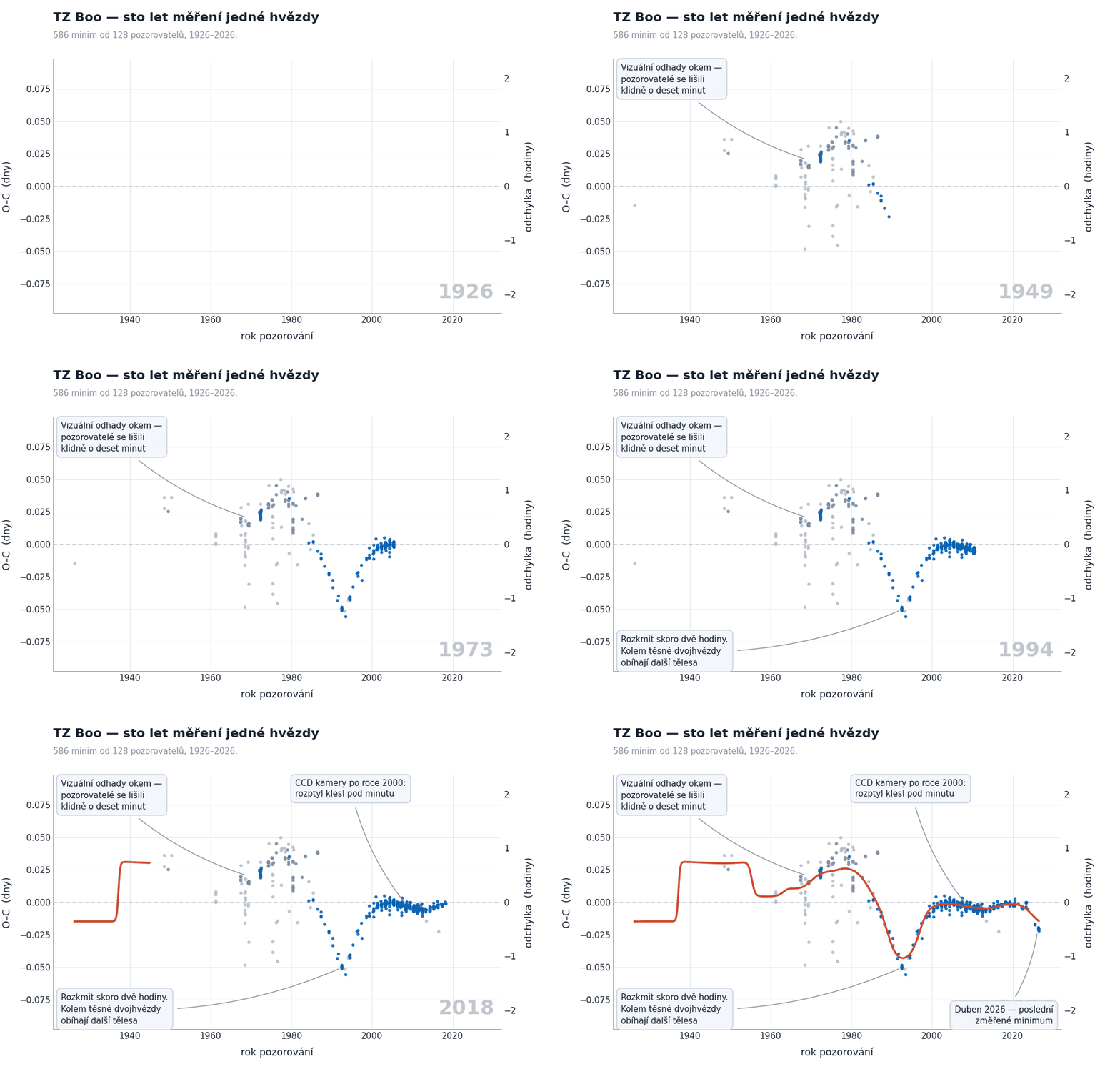
- Furthermore, many phenomena only reveal themselves in data covering decades. Such as slow period changes, apsidal motion, or a third body in a binary system.
No mission can replace a continuous series of times of minima built by generations of observers. Targets change, priorities shift, and technology continues to improve, but the involvement of observers with smaller instruments has remained beneficial under all circumstances.
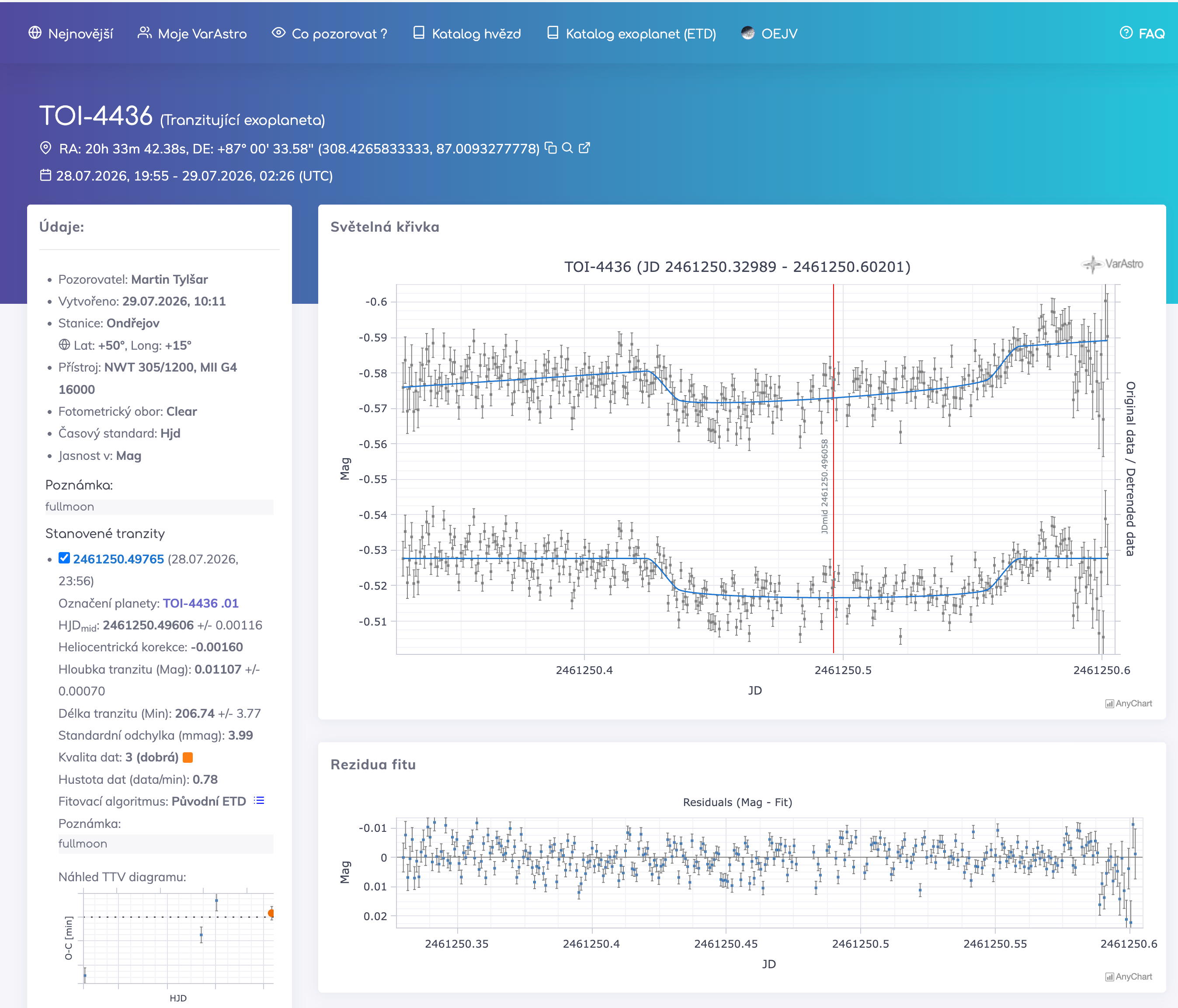
What you measure can be uploaded to the VarAstro section database. Your data is immediately available to others, with your name attached to the observation, and from there the path continues:
- To international projects. Our section has operated the Exoplanet Transit Database (ETD) since 2008, and it is used by observers and professionals worldwide. Measurements from it can contribute to the preparation of the European ARIEL mission as part of the ExoClock project. Your night at the telescope can thus help point a real space telescope at the right star at the right moment.
- To professional publications. Data from section members appears in professional articles—in the section journal OEJV as well as in international peer-reviewed journals, where amateur observers are often co-authors. And sometimes a single night is enough: the brightening of the star V838 Monocerotis, first recorded by our section member Ladislav Šmelcer, launched research that continues to change our understanding of stellar mergers—read more in the article here.
But these are all rational reasons. The main one comes when you see your first own light curve—data that no one had before you. For some, it even brings a better feeling than looking at a beautiful starry sky. But that cannot be conveyed; you simply have to measure it yourself.
How to get involved
There are several ways to get involved. Choose the one that suits you.
We will show you what you need for your first measurement, how to process it, and where to upload it. Even if you don’t have your own equipment.
Membership will connect you with people who have been measuring variable stars for decades and will give you access to the section telescope and our events.
The easiest first step is to meet us in person—at a conference, a workshop, or at VarCafé.
Where to get more information
Whatever you are looking for, you aren’t starting from scratch with us. Below you will find a guide to the most useful resources, followed by a library of lectures, articles, and downloadable materials that we continuously update.
Before you start measuring
We have the basics written down right here: what types of variable stars exist, what an exoplanet transit looks like, and what photometry entails.
Where to look and where to send data
We often look for targets right here. Measurements don’t end on your hard drive. VarAstro is our section’s database, VSX is the American international catalog of variable stars, and SIMBAD is the European stellar catalog.
Learn from others
The fastest way to learn is from someone who is already doing it. Lectures, conferences, and VarCafé—most recordings are free to watch on our YouTube channel.
Library
Lectures and videos
Literature and articles
📄 Observing Variable Stars with a Digital SLR (Mašek, 2014)
📄 Visual Observation of Variable Stars – for beginners, includes a simulator (Brát, Šafář, 2011)
Software
💻 SIPS (Scientific Image Processing System)
📖 SIPS Manual (EN)
📖 SIPS Manual (CZ)
💻 STEP
📖 STEP Guide
Downloads
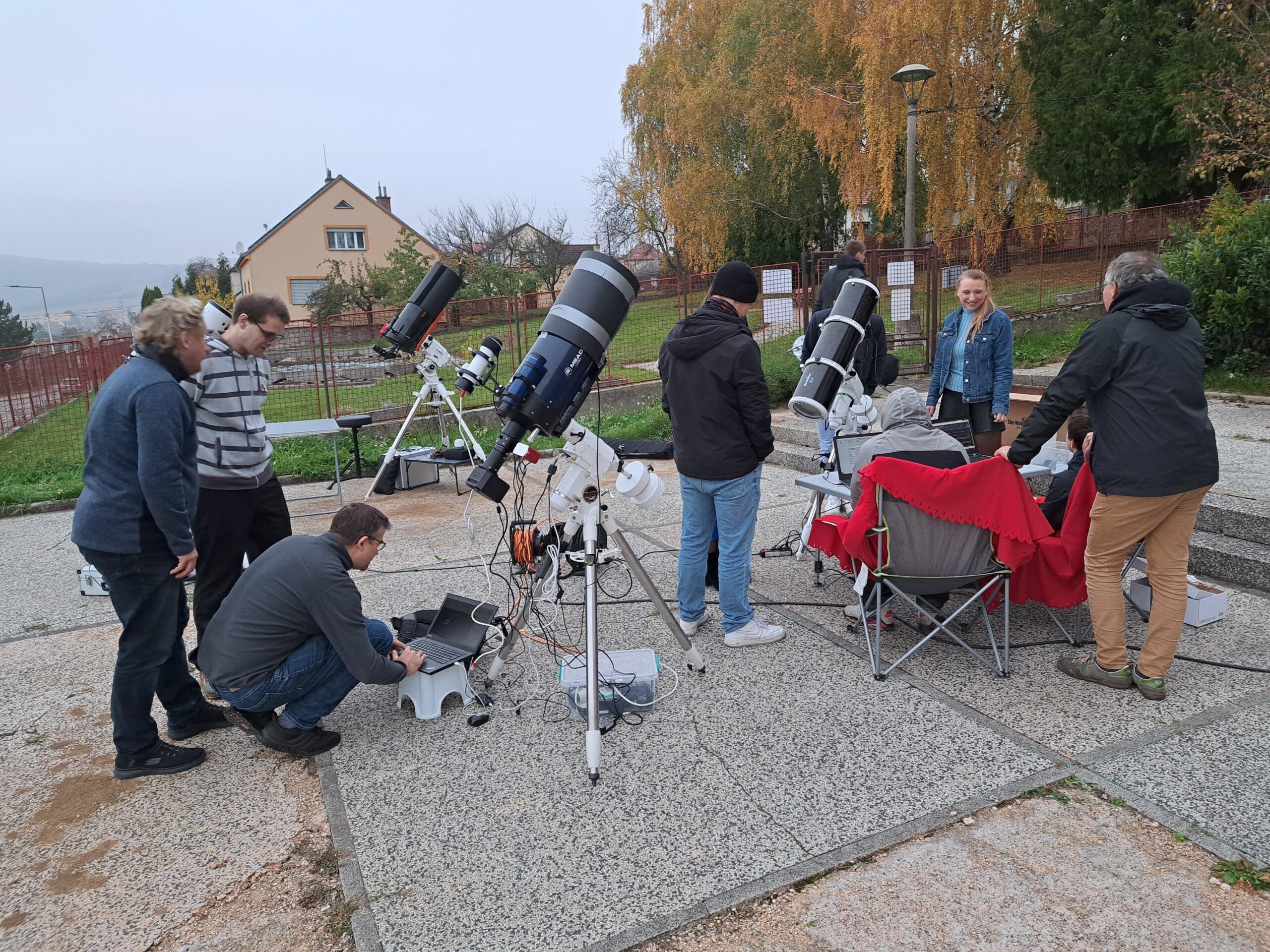
Mentoring — you won't be in this alone
The beginning is often hardest when you’re stuck on something seemingly trivial and have no one to ask. That’s why we are considering offering a mentor to everyone who joins us—an experienced section member who will help select the first target, go through data processing with you, and advise when measurements aren’t going well.
Mentors would typically be the coordinators of individual observation fields and other experienced observers. If your question falls outside their expertise, they would direct you to a colleague who focuses on that topic in depth.
Would this make sense to you? Write to us. Interest from your side is the best way to support the creation of mentoring.
Frequently Asked Questions (FAQ)
✦ Before you start
Do I need my own telescope and other equipment?
No. If you get hooked on observing, you will naturally acquire your own equipment over time. But you can start even without it! The section can help with equipment, and members can observe remotely using the section’s ROST telescope. A standard computer or laptop is enough for data processing; all necessary software is free.
Do I have to be a section member to measure and submit data?
You don’t have to. The VarAstro database is open, and observers from anywhere can upload to it. However, membership opens up everything else—access to the ROST section telescope, the assignment of a mentor if interested, consultations with coordinators of individual observation fields, conferences, workshops, and other benefits. You can find more about membership here.
I have never measured before and don't know photometry. Is that a problem?
It is not. Variable star photometry is one of the few fields where an amateur can obtain usable scientific data without a formal education. The procedure is quite simple and can be learned over a few evenings. It consists of four basic steps: image calibration, selection of comparison stars, measurement, and constructing a light curve. You can find a detailed description on the Observation page, and practical help from the coordinator of your chosen observation field.
How much time does it take? Can I observe only occasionally?
Yes, occasional observation makes sense. One successful night means one usable measurement, and these add up in the database. One measurement takes from two hours to almost an entire night at the telescope, depending on the target, plus another few dozen minutes of processing. Long-term series naturally have greater scientific value, but they are not a requirement for getting involved.
✦ Equipment
What is the smallest telescope that makes sense?
It depends on what you want to measure. For brighter variable stars, a telescope with a diameter of about 8 to 15 cm is sufficient; for the brightest targets, even a high-quality telephoto lens will do. For exoplanet transits, a diameter around 20 cm is a reasonable choice. Measurements from our section published in the ETD were made with such a telescope. However, diameter isn’t everything; the mount, camera, and other components are also important.
Do I need guiding and a precise mount?
The mount is more important for photometry than the optics. Exposures last tens of seconds to minutes, and the entire measurement runs for several hours, so the star must remain in the field and ideally in the same spot on the chip. With shorter exposures and a well-aligned mount, you can manage without guiding (automatic correction of the mount’s tracking using a guide star so the target doesn’t drift), but we recommend it for longer series.
Is a DSLR sufficient, or do I need an astronomical camera?
You can start with a DSLR, and it gives usable results for bright stars—the green channel of the Bayer mask roughly approximates the V photometric filter in its transmission. However, it hits its limits: an uncooled chip is noisy and its sensitivity changes with temperature during the night; furthermore, color mask interpolation introduces systematic errors into measurements. For precise photometry, especially for exoplanet transits where we deal with drops on the order of thousandths of a magnitude, a cooled monochromatic camera is practically essential. Paradoxically, whatever you use to measure, it pays to slightly defocus the image. The starlight spreads over more pixels, which evens out differences in their sensitivity, making the measurement more precise than with a perfectly focused image.
Do I need photometric filters? Can I measure without a filter?
You can measure without a filter, and such data is welcome in the database. For exoplanet transits, measurements are often intentionally made without a filter to obtain more signal. However, the measurement is then not tied to a standard photometric system: color indices cannot be determined from it, and there is a risk of systematic error if the target differs in color from the comparison stars. The standard is the Johnson-Cousins filter system, most commonly V and R. Alongside it, filters of the Sloan photometric system, designated u’, g’, r’, i’, and z’, are gaining ground. These have more sharply defined transmissions and are used by most modern surveys, making it easier to compare measurements with catalog data.
Can I measure from a city or a balcony?
Yes, and it’s more common than you might expect. Photometry is differential—the brightness of the target is compared with comparison stars in the same image, so the sky brightness is largely subtracted. Light pollution increases noise and reduces the limiting magnitude, but the city sky is sufficient for brighter targets. On a balcony, the heat currents rising from the building and a limited view of the sky are often greater enemies than the light itself.
✦ Processing and data
What program is used to process measurements?
We unequivocally recommend SIPS as the primary tool. It is free, independent of camera brand, and covers the entire chain from image calibration to the finished light curve (and more—it can control the entire observation, but that’s for another time). A proven alternative is Muniwin (C-Munipack). Both programs are used by section members, so we can advise you on both. You can find a more detailed description of how to work with them on the Observation page.
How is a light curve created from the images?
In four steps. First, calibration: a dark frame is subtracted from the images and they are divided by a flat field, which removes detector defects and uneven illumination. This is followed by star identification in the field and the selection of comparison stars, which should ideally be of similar brightness and color to the target. Then comes aperture photometry—summing the light in a circle around each star. The difference in brightness between the target and comparison stars over time creates a differential light curve, from which the time of minimum or the depth and duration of a transit is derived. It sounds complicated, but in SIPS, you have it done in a few minutes.
Where are observations sent? What are VarAstro and ETD?
VarAstro is the observation database operated by our section. It includes the ETD (Exoplanet Transit Database), which the section has operated since 2008 and which is unique worldwide in its focus—it collects exoplanet transit measurements from observers all over the world. After registration, you upload your measured data or finished curve and add details about the telescope, camera, filter, and observation site. Your measurement thus becomes publicly available and citable. VarAstro also offers the possibility of planning and searching for suitable observation targets. In case of any confusion, the VarAstro portal has its own FAQ section.
How precise must a measurement be to be useful for science?
There is no single universal threshold. What matters is the ratio between the scatter of your measurement and the depth of the phenomenon you are monitoring. The drop in brightness must be clearly visible in the light curve above the noise level. For eclipsing binaries, the drops are usually significant, so even measurements with a smaller telescope are useful. In contrast, an exoplanet transit is only a tiny fraction of the star’s brightness, and the precision requirements are therefore substantially higher. You don’t have to judge the quality of the measurement yourself—VarAstro will evaluate it automatically during processing.
Who will use my data, and can I get into a publication?
Data from VarAstro and ETD is used by professional and amateur astronomers worldwide—to refine ephemerides, search for other bodies in systems using O-C diagrams, and prepare observation plans for major missions. Through a partnership with the ExoClock project, transit measurements can contribute to the preparation of the European ARIEL mission. The path to publication is open: the section publishes the peer-reviewed journal OEJV, and its members can publish there. If you have interesting data, we will help you with the publication.
✦ Our Section and ROST
I don't have my own equipment—can I observe with the ROST section telescope?
Yes, that is exactly why we have a section telescope. Section members reserve observation time on it via this website; observation takes place remotely, and you download the measured data for processing. An observation log is kept for each observation, where you can also record feedback. You will find everything you need in the ROST Section Telescope section.
What should I observe, and who will advise me on the selection?
The section has long focused on four observation fields: eclipsing variable stars, multiple systems, physical variable stars, and exoplanets. Each field has its own coordinator who will help you choose a target corresponding to your equipment, sky, and the time you can devote to observation. If you have an assigned mentor, they can help with this. The most rewarding first target is usually a bright eclipsing binary with a short period—you can catch the minimum in a single evening and see the result immediately.
Where do we meet, and are the events suitable for beginners?
The section organizes an annual conference on variable stars, plenary meetings, informal VarCafé gatherings, and workshops aimed directly at beginning observers. Workshops are the best way to try out data processing with someone on hand. You can find a current overview in the Events section, and you can also contact us directly with questions.
How far can you take it?
It starts with one nightly series of images. Then comes the first time of minimum in the database, the first co-authorship of a publication, the first own article, the discovery of a new variable star. And occasionally even a star that is still being written about twenty years later—like V838 Monocerotis, which was also monitored by observers from our section.


