Exoplanets

Exoplanets — planets orbiting stars outside our Solar System — represent one of the most dynamically developing branches of modern astronomy. Their study contributes fundamentally to our understanding of the formation and evolution of planetary systems, the diversity of planetary environments, and the conditions that may lead to the existence of life. And because an exoplanet transit can now be measured even by an amateur telescope, observers from our section also have a firm place in this field.

x scaled | Exoplanets
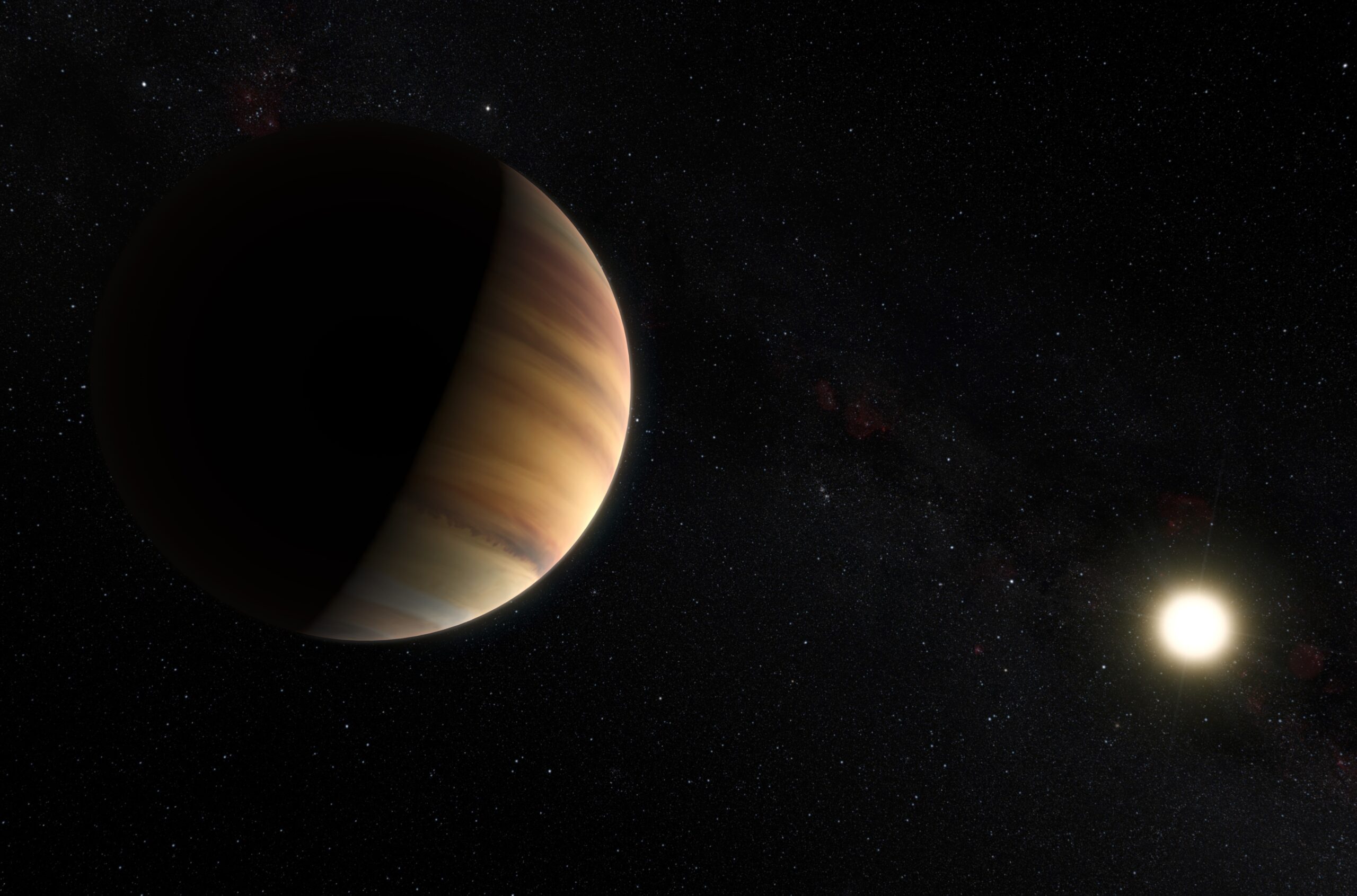
An artist's impression of the exoplanet 51 Pegasi b — a hot gas giant that orbits its star in the constellation of Pegasus once every four days. Twenty years after its discovery, star light reflected directly from the planet was captured for the first time. Credit: ESO/M. Kornmesser/Nick Risinger (skysurvey.org), CC BY 4.0.

History of Exoplanet Research

The idea of the existence of planets around other stars has appeared since antiquity, but the first scientific attempts at their detection did not come until the 20th century — and some of the earlier reports were later refuted. Surprisingly, the very first confirmed exoplanets were not found around a Sun-like star: in 1992, radio astronomers detected them around the pulsar PSR B1257+12, a remnant of a supernova explosion.

The real breakthrough occurred in 1995, when Michel Mayor and Didier Queloz announced the discovery of the planet 51 Pegasi b — the first confirmed exoplanet orbiting a Sun-like star. This hot gas giant, which orbits its star once every four days, overturned the notion that alien planetary systems must look like our own. For this discovery, both astronomers received the Nobel Prize in Physics in 2019.

An era of rapid growth in discoveries followed, particularly thanks to the Kepler mission (2009–2018), which revealed thousands of exoplanet candidates. Currently, we are cataloging more than six thousand confirmed exoplanets, and it is becoming clear that our Solar System is not unique — planetary systems are a common phenomenon in the Galaxy. Attention is therefore shifting from discovery itself to the detailed characterization of the physical and chemical properties of these worlds.

tranzit schema dark | Exoplanets
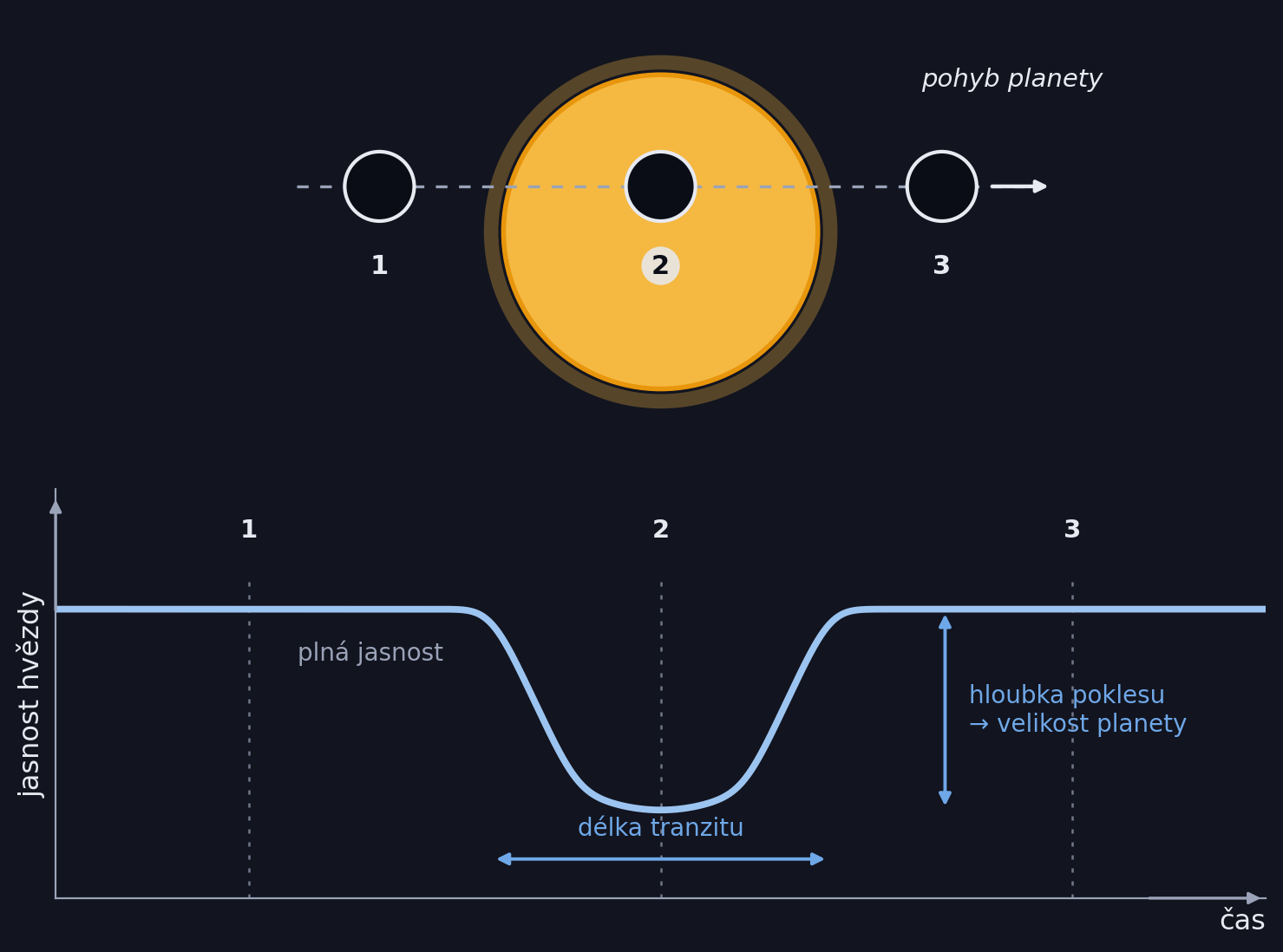
Principle of the transit method. When an exoplanet (positions 1–3) passes in front of its star's disk, it obscures a small part of its surface, and the star's brightness drops slightly for a moment. The size of the planet can be determined from the depth of the drop, and the length of its "year" from the repetition of transits. For a Jupiter-sized planet, the drop is roughly one percent; for an Earth-sized planet, it is a mere fraction of a per mille — the depth is therefore enlarged in the diagram for clarity. Schematic representation. Credit: SPHE ČAS.

How We Discover Exoplanets

An exoplanet is defined as a planet that orbits a star other than the Sun. These objects can be very diverse – from giant gas planets similar to Jupiter, to “super-Earths” with several times the mass of Earth, to small rocky planets similar to Mars.

However, their detection is extremely challenging, as they are immensely faint compared to stars and are close to sources of intense radiation. The main observation methods include:

  • Transit method – monitors regular drops in a star’s brightness when an exoplanet passes in front of it. The principle is related to eclipsing binaries — and that is precisely why this method is also the domain of amateur observers.
  • Radial velocity method – measures the subtle wobble of a star caused by the gravitational pull of a planet.
  • Direct imaging – very difficult, requires special techniques to block the star’s light.
  • Gravitational microlensing – utilizes the effect of the bending of light from a more distant star by a foreground planet.

Observations are conducted both using ground-based observatories (e.g., ESO, Keck Observatory) and through space telescopes (Kepler, TESS, JWST). And you can learn what photometric measurement looks like in practice — from the telescope to the light curve — on the Observations page.

varastro star 90445 obs 113168 | Exoplanets
A real transit in our section's data: exoplanet HAT-P-36 b captured on April 6, 2026, by a 20 cm diameter telescope from the station in Broumov. The drop in brightness of about two percent lasted just under two and a quarter hours — the original measurement is at the top, the data cleared of trends is at the bottom, the blue line is the transit model, and the red indicates its center. Observers upload similar measurements to the ETD database, where they help refine planetary parameters and predictions of future transits. Credit: VarAstro/ETD, observation by Vojtěch Školník.

Follow-up Observations

The detection of an exoplanet itself is only the first step. To confirm its existence and determine its properties, it is necessary to perform so-called follow-up (follow-up) observations. This phase includes:

  • Signal verification – ensuring that the observed changes in the star’s brightness or velocity are indeed caused by a planet, and not, for example, a binary star.
  • Mass and radius measurement – by combining the transit method and the radial velocity method, the density and thus the approximate composition of the planet can be derived.
  • Atmospheric studies – spectral analysis of transits allows for determining the composition of the atmosphere, the presence of water vapor, carbon dioxide, or other molecules.

Follow-up observations are crucial for understanding the potential habitability of exoplanets and identifying targets for future missions aimed at searching for life.

And this is precisely where space opens up for amateur observers. Within the VarAstro database, our section operates the ETD (Exoplanet Transit Database) project, to which observers from all over the world upload their transit measurements. Long series of precisely measured transits help refine planetary parameters and predictions of future transits — exactly the kind of follow-up observations that large survey missions usually do not provide themselves and that science needs. You can find more about the project in the Observation Programs.

ariel key visual esa499933 scaled | Exoplanets
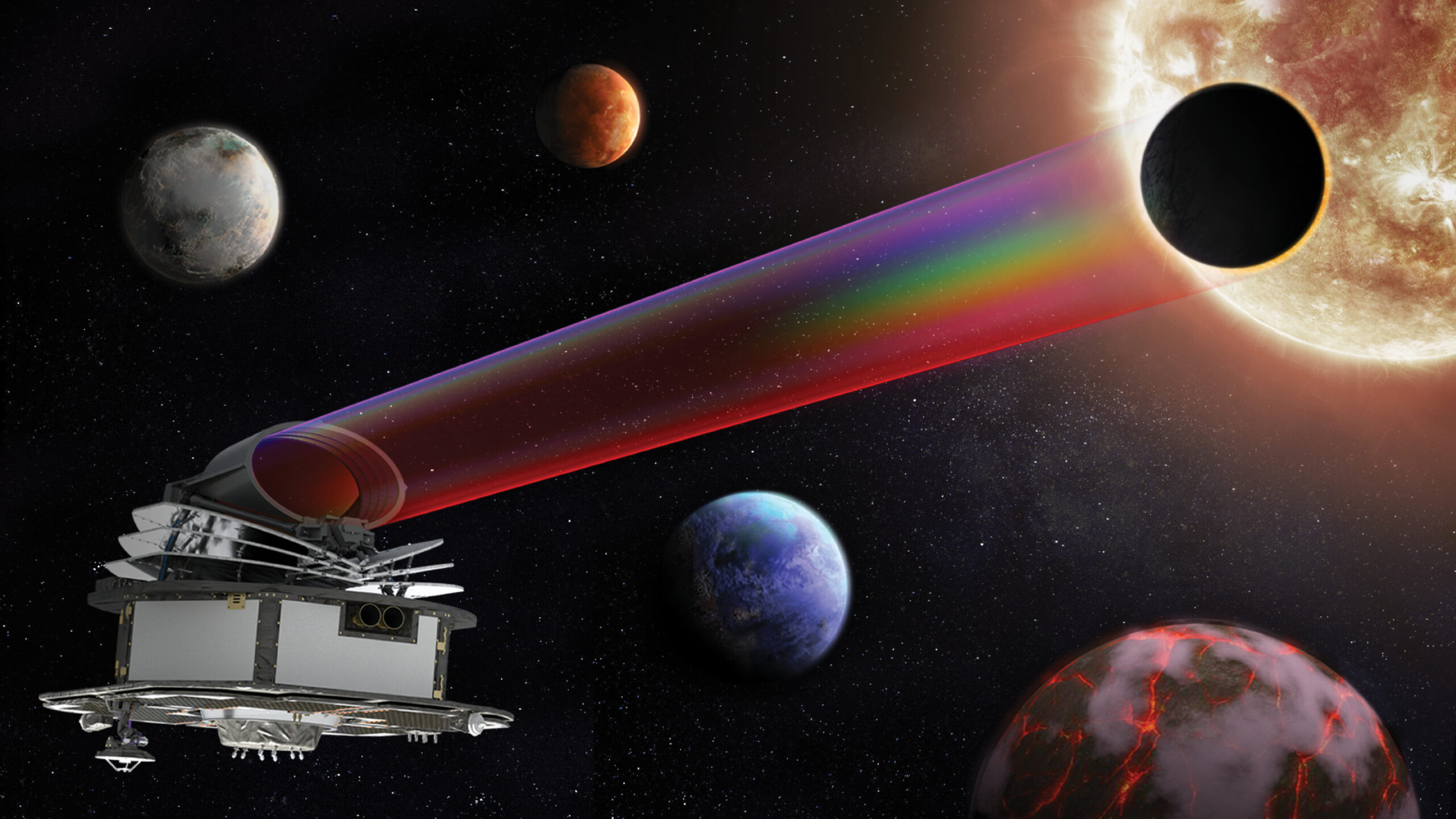
An artist's visualization of the ARIEL space telescope (ESA), which is intended to study the atmospheres of about a thousand exoplanets. To ensure no transit is missed, observers of the ExoClock project — including members of our section — prepare precise predictions for it. Credit: ESA, CC BY-SA IGO 3.0.

Scientific Collaborations

Exoplanet research is a global effort that requires the cooperation of a wide range of scientific institutions and observatories. International projects such as ESO, ESA, NASA, and numerous national agencies pool resources and expertise.

The sharing of data through publicly accessible archives (e.g., NASA Exoplanet Archive) also plays an important role, enabling the involvement of the global community of astronomers and amateur observers.

Observers from our section are also involved in the preparation of the European ARIEL mission, which is to study the atmospheric composition of about a thousand exoplanets, as part of the international ExoClock project. Its task is to continuously measure transit times and thus refine ephemerides, i.e., predictions of future transits. Thanks to them, the space telescope will point at the right star at the right moment and use its observation time as efficiently as possible. Anyone who has a telescope and a camera can get involved — the ExoClock community today brings together over 800 observers from all over the world.

Future missions, such as PLATO (ESA), the Nancy Grace Roman Space Telescope (NASA), or extremely large telescope projects on Earth, promise a fundamental breakthrough in the search for habitable worlds and potential biosignatures.
A drop in a star’s brightness of just one percent, revealing an alien world hundreds of light-years away – even this can be measured today with a telescope from a backyard. All it takes is a telescope, a detector, and the will. If you want to be part of it, our doors are open to you.

  • If you are interested in what we do, you are in the right place. Start here, for example – Section Activities
  • If you have further questions and would like to discuss them with someone, contact us.
  • If you are determined to measure your first exoplanet on our section telescope – join us.