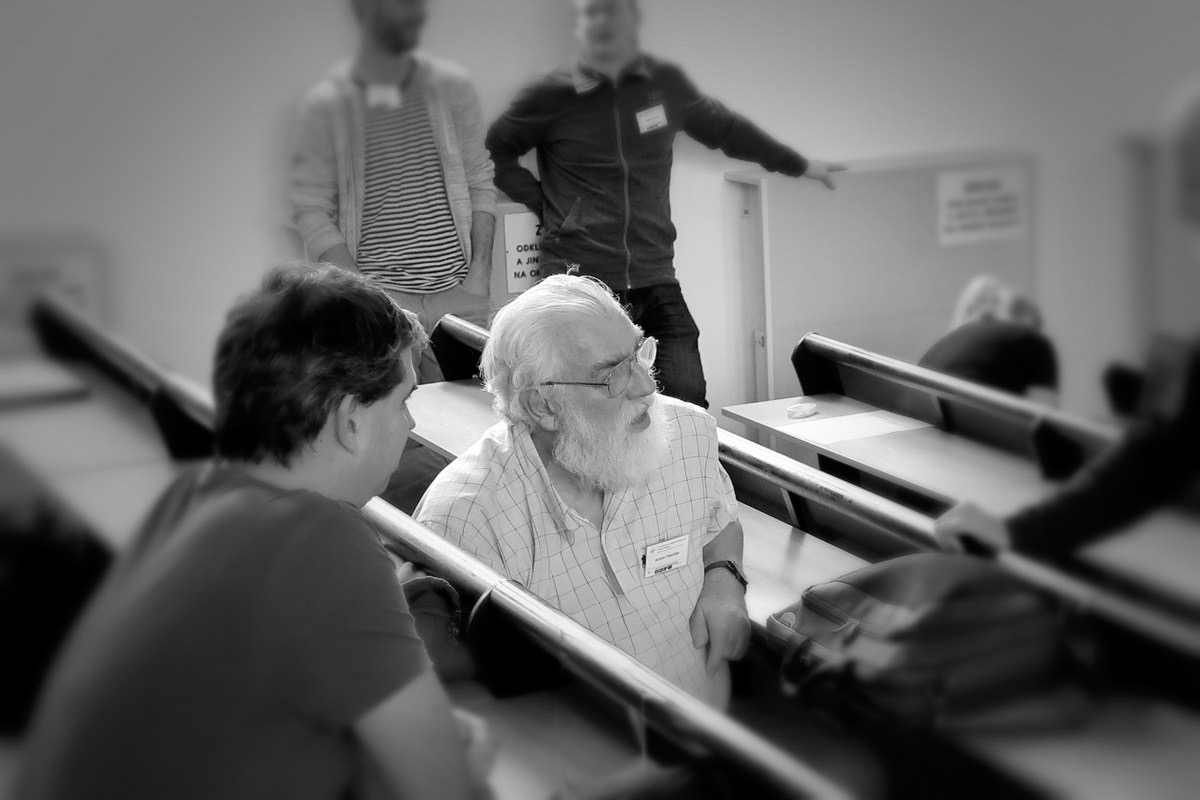
Anton Paschke has passed away
Anton Paschke has passed away
It is with deep sorrow that we announce that Anton Paschke (born September 20, 1946), a long-time member of the Variable Star and Exoplanet Section of the Czech Astronomical Society and one of the most prominent figures in amateur research of eclipsing binaries in Europe, passed away on October 10, 2026, at the age of 80.
The name Anton Paschke is known to anyone who has ever searched for the elements of an eclipsing binary. Together with Luboš Brát, he was at the birth of the O-C Gateway (var.astro.cz/ocgate), a worldwide database of times of minima, which he then for many years tirelessly and meticulously supplemented and maintained himself. The database grew to hundreds of thousands of minima and was one of the most visited parts of our website. It was cited by amateurs and professionals around the world, and its data still lives on in the current var.astro.cz.
He had been a member of the section since at least 1998, and in 2002 he was elected to the committee of what was then the B.R.N.O. section. Later he served on the editorial board of the Open European Journal on Variable Stars and published a number of lists of minima in it himself. Together with Petr Zasche, he participated in a study of the eclipsing binary HS Hydrae, whose eclipses are gradually disappearing. We last welcomed him among us at our conference in 2018.
He lived in Rüti, Switzerland, and was also active in the German BAV (the German association of variable star observers), so he formed a natural bridge between the Czech and German-speaking observer communities. He published in the BAV Rundbrief for more than three decades and regularly reported there on developments in our community.
He was not only a database administrator, but also a passionate observer. As Reinhold F. Auer recalls, he was, together with Miloš Zejda, among the most active observers of all. He traveled to Namibia for the southern sky and observed remotely with the BAV telescope in Carona. Together with Robert Uhlař, he built the first remote observatory at the Ca’ del Monte site in Italy. It was probably he who invented the so-called Malokuk, a lens with a CCD camera on a small mount. He installed one of these on the Cape Verdean island of Fogo and controlled it over the internet until the station was buried by lava during a volcanic eruption.
Pavel Cagaš recalls their first meeting: After several emails, Anton came to the company in person to pick up one of the first G2 cameras. He made such an impression on the receptionist at the time that she reported to her colleagues: “A gentleman from Switzerland has arrived, and he says he’s here for our camera.”
Honor to his memory.